
Laser Science. Light Can Do Way More Than Just Bend

You’ve heard about how lasers work, but what does this mean for science?! We see everyday how light interacts with matter. Ever wonder how a rainbow is formed? Or why your straw looks bent or even broken when it is placed in a cup of water? Both of these phenomena have to do with light interacting with matter. If we use high powered lasers as our source of light we can observe even more awesome effects—yes, cooler than a rainbow.

So back to how a straw appears to break in a cup of water.

The straw appears "broken" due to a property of light known as refraction. Image adapted from source. http://www.flickr.com/photos/ejpphoto/3444081361/

The straw appears “broken” due to a property of light known as refraction. Image adapted from source.

Continue reading

How Do Scientists in Four Different States Work Together?

Science doesn’t always look like this:

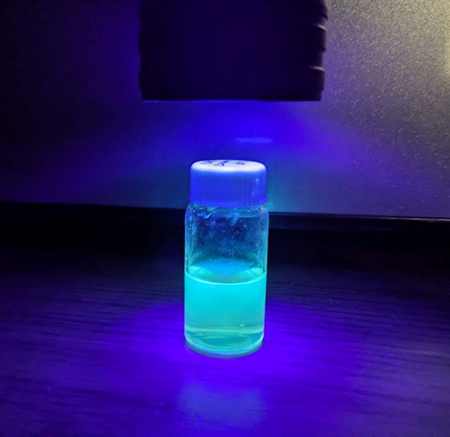
Mimi synthesizing some "quantum dot" nanoparticles.

Mimi synthesizing some “quantum dot” nanoparticles.

Sometimes it looks like this!

Science is happening!

Science is happening!

We have scientists in Wisconsin, Illinois, Minnesota, and even Washington!  Every week we get together for a videoconference to coordinate all the different kinds of research happening here at the Center for Sustainable Nanotechnology.  Above is a series of screenshots Franz Geiger took during our meeting yesterday afternoon.

Science!!!

Nature’s Nanomachines Harnessed to Enable Healthier Delicious Ice Cream

The first ice cream worthy day of the year!

The first ice cream worthy day of the year!

To me, one of the most interesting aspects of nanotechnology is how close in size the nanoparticles we can make are to the nano-sized components of living organisms. These nano sized proteins, lipids and nucleic acids have evolved to form the network of biological machines to support the abundance of life on this planet. Just as we have only begun to understand how to engineer and control synthetic nanotechnology, we are similarly limited in our knowledge of nature’s nanomachines. While some biological nanotechnology has been used by inventive humans for centuries to brew beer or bake bread, we are just beginning to discover some of the potential applications of these complex and fascinating tools. As the weather here has turned warmer (well, sort of…), the thoughts of this scientist have turned to how one of these newly discovered biological nanomachines can change that most refreshing of summer treat: ice cream. Continue reading

Surfing Particles: taking a ride using living cell machinery

Some cells in our body have elongated structures or microvilli at their surface. These microvilli have many functions that help the cell to survive, and some features that make them act like train tracks that shuttle substances along them. We recently captured a movie of nanoparticles hitching a ride on these cellular train tracks. Nanoparticles are able to do this because they are just about the right size to impersonate other cellular components. Additionally, they have some unique and powerful properties that larger particles made of the same components simply don’t have.

The cellular

Microvilli, the cellular train tracks—some of which are indicated by black arrows. Image adapted with permission from ACSnano Copyright 2007 American Chemical Society

Continue reading

Fluorescent Nanodiamonds – the movie!

Nanodiamonds are far too small to be seen by the naked eye, but everything changes if you make them glow! We at the Center for Sustainable Nanotechnology have developed a new way to make nanodiamonds absorb and then release light—a property known as fluorescence (see this explainer post). I just made these fluorescent nanodiamonds and did an experiment on them in order to see them glow. I put them in water, and with the help of scientists in the Goldsmith group here at UW-Madison I shined laserlight on them and here is what I saw through a microscope.

Continue reading

Beer and Nano-sustainability

Not nano-beer, mega-beer! Image source.

Not nano-beer, mega-beer! Image source.

Beer. It’s one of humanity’s finest inventions and is the topic of several blogs on its own. There is a lot that beer can teach us. For example, recently a group of hard working scientists invented a new way to brew batches of nanoparticles that is reminiscent of beer brewing. For those of you not familiar with the beer making process, you start by boiling grains and hops in water to create a sugary liquid called wort. After removing the solids, you add the fungus yeast to the wort. As the beer ferments the yeast break down the sugars and create alcohol and carbon dioxide. Once the yeast is finished, it settles out, is separated and we have the glorious final product that is beer.

Enter the fine scientists working over at the Oak Ridge National Laboratory (Fun fact: this same facility was originally founded as part of the Manhattan Project). They, along with their Korean collaborators, have come up with a way to allow bacteria to create nanoparticles by breaking down larger materials. Scientists have known for years that some types of bacteria are able to release chemicals which can break down metals and turn them into a usable form for the organism, but this is a bit different.  This new synthesis takes a similar biological process to a new level by using it to create very specific varieties of nanoparticles with multiple potential industrial applications. Continue reading

In which my Mom questions the size of my nanoparticles

I was talking to my mom the other day, about nanoparticles of course, and she said: “Wait a second! Are there different sizes of nanoparticles??  I thought nano was just nano! You know?”

Thanks for the question  mom!  :-)

My Mom and niece.  They are not nanoparticles.

My Mom and my niece. They are not nanoparticles.

Refresher: nanoparticles are just spherical or nearly-spherical nanomaterials.

To answer my mom’s question: There are LOTS of different sizes of nanoparticles.  Here is an animation I made showing 8 nanoparticles of different sizes—starting with a single atom just for comparison.

Lots of different sized gold nanoparticles, with a gold atom for comparison.

A gold atom and gold nanoparticles of 8 different sizes. Note #1: “nm” is an abbreviation for “nanometer”, which is 1 billionth of a meter. Note #2: I made this using just one of the AMAZING things on the MRSEC website.

“Why did my Mom have that impression?”, I wondered. Continue reading